
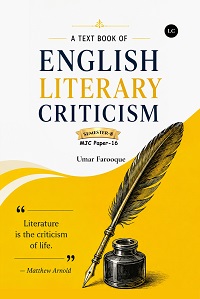
“This volume provides a comprehensive introduction to some of the most significant texts and movements in English literary criticism, combining historical context with critical analysis. Intended for students, researchers, and general readers, it explores the ideas and theoretical approaches that have shaped literary studies from the Romantic age to the contemporary period.
The book opens with William Wordsworth’s Preface to Lyrical Ballads (1802), a landmark Romantic statement that redefined poetry as the expression of genuine human emotions conveyed through ordinary language. It is followed by S.T. Coleridge’s Biographia Literaria (Chapters XIII and XIV), which develops a philosophical understanding of imagination and artistic creation.
The Victorian perspective is represented by Matthew Arnold’s The Study of Poetry, which highlights the moral and cultural importance of poetry. The early twentieth century is explored through T.S. Eliot’s influential essays Tradition and the Individual Talent and The Functions of Criticism, which transformed modern views of literary tradition and critical practice.
Attention then turns to I.A. Richards, whose Principles of Literary Criticism and Practical Criticism introduced a more systematic and analytical method of textual interpretation, laying the foundation for modern critical approaches.
The concluding section surveys major modern literary trends, including Formalism, Modernism, Postmodernism, Structuralism, Post-Structuralism, Deconstruction, Feminism, Marxism, and Post-Colonialism. Each movement is discussed in terms of its origins, key concepts, and contribution to literary studies.
By bringing together primary texts, critical commentary, and theoretical overviews, this book equips readers with essential tools for literary analysis and encourages a deeper appreciation of criticism as a dynamic and evolving intellectual discipline.”



Reviews
There are no reviews yet.