
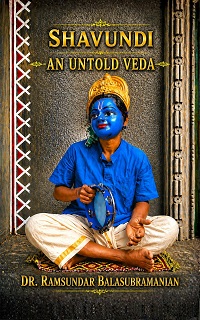
“Shavundi” refers to an individual who performs specific funeral rites and serves as a representative of the deceased, often residing near cremation grounds. It is a term closely linked to death rituals, in which such a person is considered essential to the ceremony, though often viewed as frightening, unlucky, or impure.
Shavundi Brahmins are said to come from the less privileged sections of the Brahmin community. Usually, some Brahmins tend to perform only auspicious rituals and may not agree to conduct last rites. Hence, those who are unable to obtain assignments for auspicious rituals may perform cremation rituals instead. Moreover, several Brahmins, both in the past and today, perform both types of rituals.
The book Shavundi-An Untold Veda narrates the life of a Brahmin man, Ishwaran Iyer, who is compelled by circumstance to perform death-related rituals and the manner in which he endures the resulting social ostracism.
Years later, his grandson, Vedant Iyer, rises to challenge these deep-rooted prejudices by willingly embracing the role of a Shavundi. Through his courage, wisdom, and unwavering conviction, Vedant seeks to prove that performing funeral rites is not a curse, but a sacred duty that upholds dignity, compassion, and spiritual responsibility. He plays a pivotal role in reshaping societal perceptions, transitioning from a victim of systemic oppression to promoting beliefs that foster dignity and respect for Shavundi Brahmins.




Reviews
There are no reviews yet.