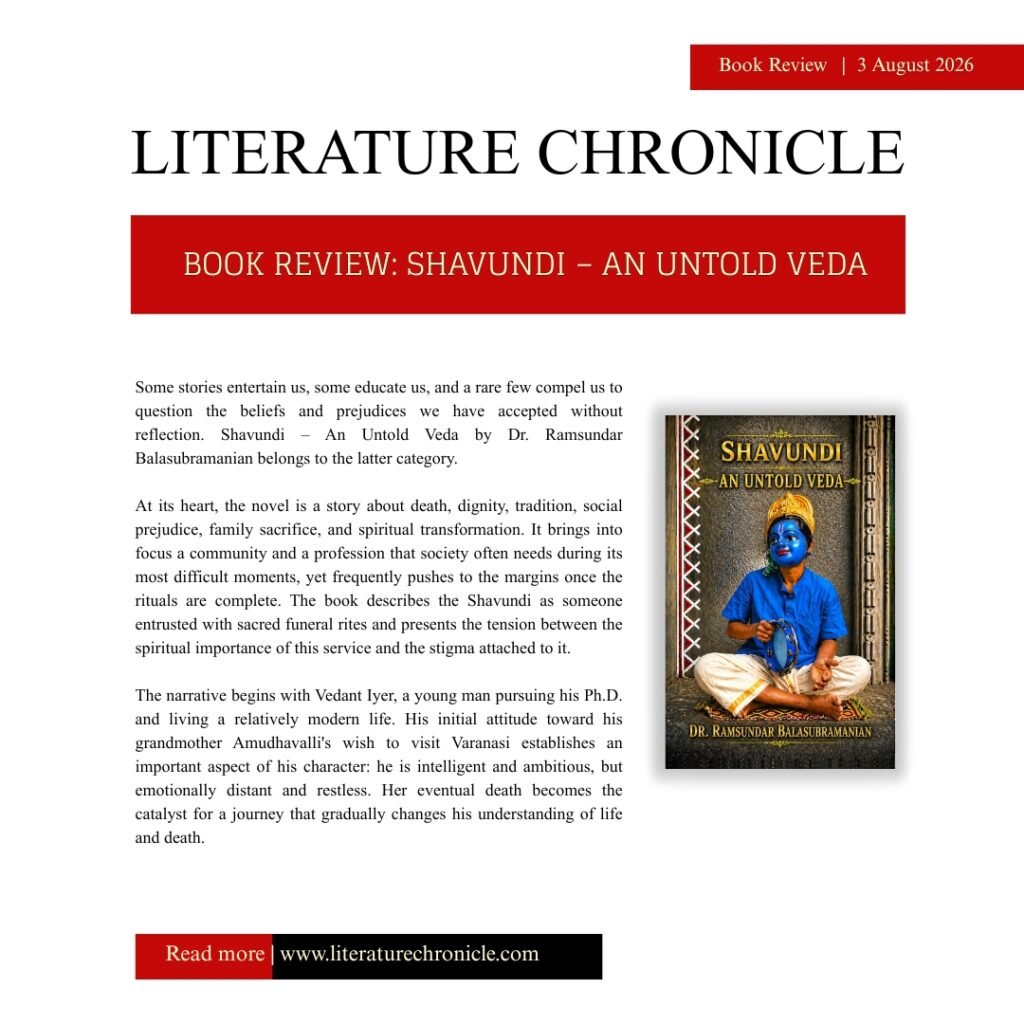
Some stories entertain us, some educate us, and a rare few compel us to question the beliefs and prejudices we have accepted without reflection. Shavundi – An Untold Veda by Dr. Ramsundar Balasubramanian belongs to the latter category.
At its heart, the novel is a story about death, dignity, tradition, social prejudice, family sacrifice, and spiritual transformation. It brings into focus a community and a profession that society often needs during its most difficult moments, yet frequently pushes to the margins once the rituals are complete. The book describes the Shavundi as someone entrusted with sacred funeral rites and presents the tension between the spiritual importance of this service and the stigma attached to it.
The narrative begins with Vedant Iyer, a young man pursuing his Ph.D. and living a relatively modern life. His initial attitude toward his grandmother Amudhavalli’s wish to visit Varanasi establishes an important aspect of his character: he is intelligent and ambitious, but emotionally distant and restless. Her eventual death becomes the catalyst for a journey that gradually changes his understanding of life and death.
Varanasi becomes much more than a physical location in the story. The Ghats, the Ganga, funeral fires, prayers, priests, and pilgrims create an atmosphere in which Vedant begins to confront questions he had previously avoided. His experience at the Ghats gradually changes his perception of death from something frightening or uncomfortable into something connected with acceptance, spirituality, and the larger cycle of existence.
One of the novel’s strongest narrative devices is the discovery of Ishwaran Iyer’s autobiography, The Untold Life of a Shavundi Brahmin. The manuscript becomes a bridge between generations, allowing Vedant to discover the life of a grandfather he never truly knew.
Ishwaran’s story provides the emotional foundation of the book. He begins with aspirations beyond traditional expectations, dreaming of education and a different future. Circumstances, however, gradually push him toward temple service and eventually funeral rituals. When society begins to identify him primarily through the label of “Shavundi,” he experiences exclusion, humiliation, and discrimination despite performing a service that grieving families depend upon.
This contrast is perhaps the book’s most compelling theme: people may depend upon someone during their greatest moment of grief while simultaneously refusing to give that person dignity in ordinary life. Ishwaran’s experience makes the reader reconsider the difference between social status and genuine service.
The emotional impact becomes particularly strong when Ishwaran is denied even simple dignity because of his association with death rituals. Yet instead of abandoning his responsibilities, he continues performing them with sincerity and compassion. His belief that every soul deserves a dignified farewell gives the character moral strength and prevents the story from becoming merely an account of suffering.
Vedant’s transformation is therefore not simply a change in profession or belief. It is a change in consciousness. The young man who initially treats his grandmother’s wishes impatiently gradually becomes someone who recognizes the value of sacrifice, tradition, service, and spiritual responsibility.
The relationship between Vedant and Ishwaran also gives the novel its generational dimension. Ishwaran sacrifices his own opportunities so that his son Raghavan can receive an education and achieve social respectability. Raghavan eventually recognizes that his father’s sacrifices enabled his own success. Vedant, in turn, discovers that his grandfather’s life contains a legacy far greater than the social identity imposed upon him.
Another notable strength is the book’s use of Varanasi and the cremation ground as symbols. Rather than portraying the cremation ground merely as a place of death, the narrative gradually transforms it into a space of truth, equality, reflection, and spiritual awakening. In the climactic scenes, Vedant begins to understand death not simply as an ending but as part of a larger spiritual cycle.
The title, Shavundi – An Untold Veda, is therefore meaningful. The “untold” aspect refers not only to a forgotten family history but also to a larger social story that the author wants readers to acknowledge. The book asks an uncomfortable but important question: Why do we seek the services of people associated with death when we need them most, yet allow social prejudice to diminish their dignity?
Dr. Ramsundar Balasubramanian’s narrative combines family drama, social commentary, spirituality, and emotional storytelling. The story is particularly effective when it focuses on the personal experiences of Ishwaran and Vedant rather than simply explaining the social issue. The emotional connection between grandfather and grandson gives the larger theme a human face.
At the same time, the book invites readers to approach its depiction of traditions and social practices as part of its fictional narrative rather than as a definitive historical or sociological account. The manuscript itself identifies the work as fiction and states that its characters and incidents are presented fictitiously.
Shavundi – An Untold Veda is ultimately a story about seeing dignity where society has learned to see stigma. Through Ishwaran’s sacrifices and Vedant’s transformation, the novel encourages readers to look beyond labels and recognize the humanity behind rituals that are often avoided or misunderstood.
It is a thought-provoking read for those interested in Indian traditions, spirituality, family relationships, social prejudice, death rituals, and stories of personal transformation.
More than a story about death, Shavundi – An Untold Veda is a story about how we choose to live, serve, remember, and respect one another.
Rating: ★★★★☆ (4/5)
Recommended for: Readers interested in spiritual fiction, social themes, Indian cultural traditions, family narratives, and stories of transformation.