
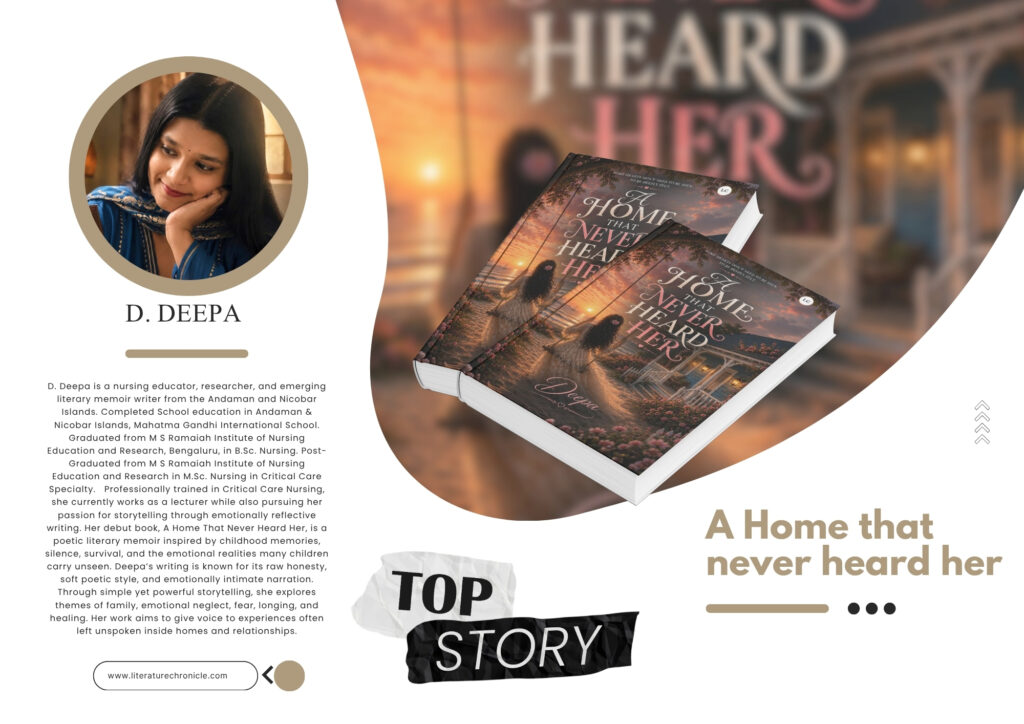
- How did your journey as a writer begin? What inspired you to start writing?
Author: My journey as a writer did not begin with confidence or dreams of becoming an author. It began with silence. For years, I carried emotions and memories that I never truly spoke about. Writing slowly became the only place where I could finally express what I had buried inside for a long time. Many moments from my childhood stayed with me deeply, and one day I realized those memories deserved a voice. That is how A Home That Never Heard Her was born — not from imagination alone, but from emotions that refused to stay silent anymore.
- What genres, themes, or subjects do you prefer to write about, and why?
Author: I naturally connect with emotional memoirs, poetic prose, psychological emotions, and human relationships. I write a lot about childhood memories, emotional pain, silence inside families, loneliness, healing, and the desire to feel loved and heard. I think I write about these themes because they are deeply personal to me. I want readers to feel emotions rather than just read words. I want people who have gone through similar experiences to feel understood.
- Was there a particular book, author, or incident that influenced your decision to write?
Author: More than a book or author, it was my own life experiences that pushed me toward writing. Certain childhood incidents stayed inside me for years — moments that looked small to the world but felt heavy to a child’s heart. I realized many people carry similar silent wounds but never speak about them openly. That realization influenced me deeply and gave me the courage to finally write my story.
- What challenges or obstacles have you faced in your writing journey, and how did you overcome them?
Author: The hardest challenge was emotional, not creative. Writing this book meant revisiting memories I had spent years trying to forget. Some chapters were emotionally exhausting to write because I was reliving pain while turning it into words. There was also self-doubt — wondering if people would understand my writing style, my simplicity, or my truth. But I kept reminding myself that honesty matters more than perfection. Slowly, writing stopped feeling like pain alone and started feeling like healing too.
- Can you recall a memorable moment or incident related to your writing that deeply impacted you?
Author: One of the most emotional moments was realizing that my story might help someone else feel less alone. While writing certain chapters, I would often stop because the memories became too overwhelming. But at the same time, I felt like the little girl inside me was finally being heard after years of silence. That feeling impacted me deeply. It made me understand that writing is not just storytelling — sometimes it is survival.
- What message, thought, or emotion do you try to convey through your books or poems?
Author: Through my writing, I try to convey that emotional wounds are real, even when they are invisible. Not every scar can be seen physically. Some stay quietly inside people for years. I want my readers to understand the importance of kindness, softer words, emotional safety, and listening. Most importantly, I want children and adults carrying silent pain to know that their feelings matter and that survival itself is a form of strength.
- Which of your writings is closest to your heart, and why?
Author: A Home That Never Heard Her will always remain closest to my heart because it carries pieces of my real emotions, memories, and childhood experiences. Every chapter holds something personal. It is not just a book to me — it feels like giving a voice to the younger version of myself who stayed silent for too long. Writing it was painful, but also freeing.
- If you had to describe your identity as a writer in one line or belief, what would it be?
Author: “I write for every heart that learned to stay silent before it learned how to heal.”
- How do you see yourself evolving as a writer in the future? Are there any upcoming projects or genres you wish to explore?
Author: In the future, I want to explore deeper emotional fiction, poetry-based storytelling, and psychological themes related to love, identity, healing, and human emotions. I also want to experiment with stories that blend reality and fiction in a more cinematic and poetic style. As a writer, I hope to grow not only in skill but also in emotional depth, while continuing to create stories readers can truly feel.
- What advice or message would you like to give to aspiring writers or readers?
Author: Do not wait to become perfect before you start writing. The most powerful writing often comes from honesty, not perfection. Write what you truly feel. Readers connect more with emotions than complicated words. And to readers — never underestimate the impact of kindness, especially toward children. Sometimes the smallest moments stay with people for a lifetime.